
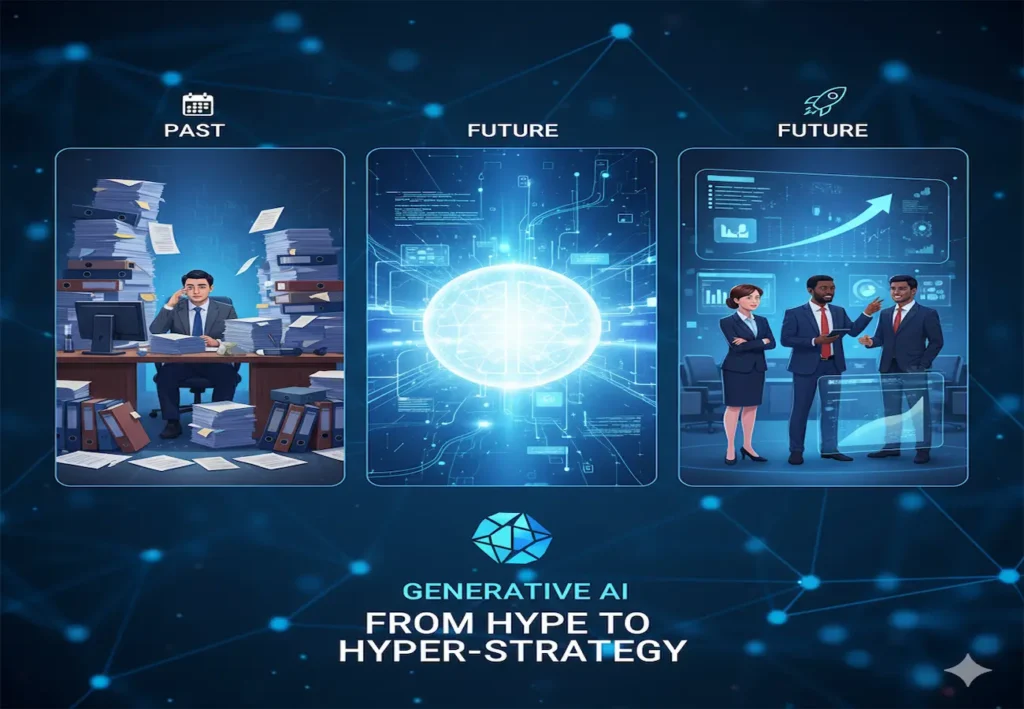
It feels like every boardroom, every conference, and every coffee break conversation is circling back to one thing: Generative AI (GenAI). From generating compelling marketing copy to coding complex software, its capabilities are evolving at a breathtaking pace. But beyond the dazzling demos and viral content, there’s a critical question businesses must answer: How do we move beyond experimenting with GenAI and embed it into our core strategic framework?
As a consultant who’s seen waves of technological disruption, I can tell you this much: GenAI isn’t just another tech trend; it’s a fundamental shift that demands a hyper-strategic approach, not just a tactical one.
The GenAI Tsunami: More Than Just a Tool 🌊
Unlike previous forms of AI that primarily focused on analysis and prediction, Generative AI creates. It writes, designs, codes, and synthesizes. This creative capacity is what makes it a game-changer, impacting virtually every function within an enterprise:
- Marketing & Sales: Personalized content generation at scale, hyper-targeted campaigns, dynamic ad creation.
- Product Development: Rapid prototyping, code generation, design iteration, synthetic data for testing.
- Customer Service: Advanced chatbots capable of nuanced conversations, personalized support, and content creation for FAQs.
- Operations: Optimized supply chain planning, automated report generation, intelligent document processing.
- Human Resources: Streamlined recruitment, personalized training materials, enhanced internal communication.
The potential for efficiency gains, cost reductions, and innovation is staggering. However, simply allowing teams to “play” with ChatGPT or Midjourney isn’t a strategy. It’s a missed opportunity, or worse, an open door to unmanaged risks.
Crafting Your GenAI Hyper-Strategy: Key Pillars 🏗️
So, how do you move from piecemeal adoption to a cohesive, impactful GenAI strategy? It starts with these critical pillars:
- Vision & Value Alignment: “What do we want GenAI to do for us?” This isn’t just about efficiency; it’s about competitive advantage. Do you want to radically differentiate your customer experience? Accelerate R&D? Optimize a specific value chain? Your GenAI strategy must directly support your overarching business objectives. Identify high-impact use cases that deliver tangible value, not just cool tech.
- Data & Governance: “Do we have the fuel, and are we driving safely?” GenAI models are only as good as the data they’re trained on. A robust data strategy – encompassing quality, accessibility, security, and privacy – is paramount. Equally important is establishing clear governance: who owns the GenAI initiatives? What are the guardrails for deployment? How do we monitor for bias, factual accuracy (“hallucinations”), and intellectual property infringement? These aren’t afterthoughts; they are foundational to sustainable adoption.
- Talent & Culture: “Are our people ready for their new co-workers?” GenAI will undoubtedly change job roles. This requires a proactive approach to upskilling and reskilling your workforce. Everyone, from the C-suite to frontline employees, needs a degree of “AI literacy.” Foster a culture of experimentation balanced with responsible use. The goal isn’t to replace humans, but to augment them, freeing up time for higher-value, more creative, and strategic tasks.
- Technology & Ecosystem: “What’s our tech stack for the future?” Deciding whether to build, buy, or partner for GenAI capabilities is a complex architectural decision. Do you leverage large language models (LLMs) from major providers, fine-tune open-source models, or develop proprietary solutions? This involves assessing your existing tech infrastructure, cloud strategy, and integration capabilities. A modular, adaptable approach will be key.
- Risk Management & Ethics: “Are we building trust, not just tools?” The ethical considerations of GenAI are profound. Bias in training data, the potential for misinformation, data security, and copyright issues are real. Your strategy must include a robust framework for identifying, assessing, and mitigating these risks. Building public and internal trust in your GenAI applications is as important as their functionality.
The Imperative for Action ⏳
The speed at which GenAI is evolving means that businesses cannot afford to sit on the sidelines. Those that embed Generative AI strategically, proactively addressing both its immense opportunities and its inherent risks, will be the ones that define the next decade of their industries.
It’s time to elevate GenAI from a fascinating phenomenon to a central pillar of your corporate strategy. The conversation needs to shift from “what can GenAI do?” to “what should GenAI do for our business, and how do we ensure it’s done responsibly?” The future isn’t just coming; it’s being generated, and you need a plan to shape it