
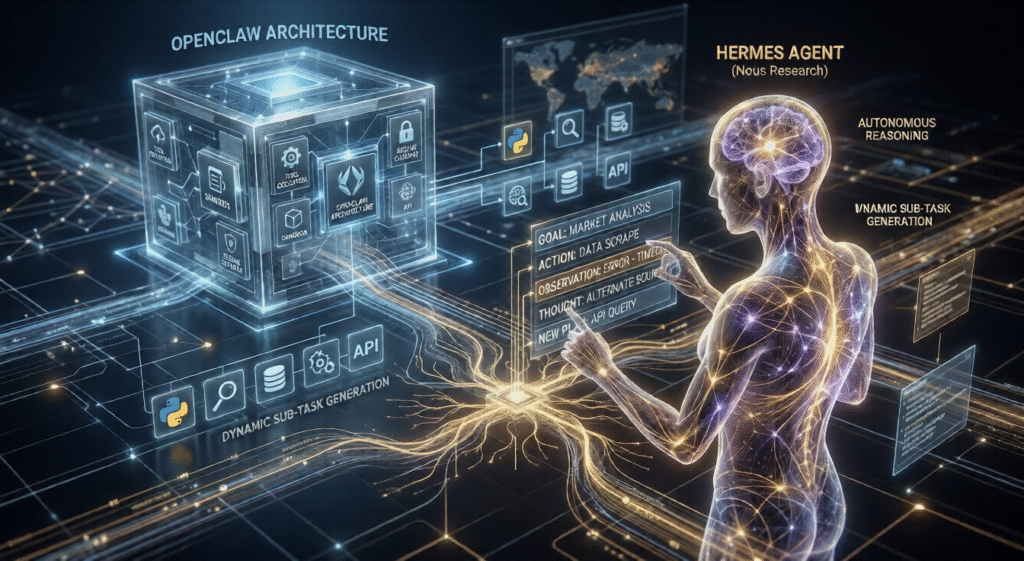
Remember the digital earthquake that was the arrival of OpenClaw? It wasn’t just another machine learning model; it was a conceptual leap, a framework for deploying truly autonomous digital agents that could understand, navigate, and execute complex workflows across the digital world. I wrote just last week about how OpenClaw wasn’t just picking up pace, but rewriting the entire roadmap for AI integration. It represented the “How.”
But, the speed of this field is, frankly, breathtaking. Just as the ecosystem was beginning to metabolize OpenClaw’s architecture, a new challenger has emerged, one that suggests the “How” is about to meet an explosive new “What.” That contender is the Hermes Agent from the team at Nous Research.
If OpenClaw is the engine and chassis for a self-driving digital car, Hermes Agent might just be the superhuman driver with an intuitive understanding of the destination.
This isn’t just another competitor; this is a paradigm shift in the definition of an AI agent.
The Problem of “Dumb” Agents
To understand the Hermes breakthrough, we first have to admit the limitations of current agent architectures (even, to some extent, OpenClaw). While OpenClaw is incredible at executing code and managing tools across an environment, it still frequently relies on the primary Large Language Model (LLM) at its core for its high-level reasoning.
Standard LLMs, brilliant as they are, are “generalists” trained on massive, unstructured corpora. They understand language, but they don’t natively understand goal-oriented, iterative reasoning. If an agent is a digital manager, the standard LLM core is like a manager who has read every business textbook but has never spent a single day on a shop floor.
When faced with a complex, multi-step goal, generalist agents can easily get “stuck.” They generate a single plan, execute the first step, and if the environment reacts in an unexpected way (as the real world always does), they often fail to self-correct, hallucinate a logical “out,” or require human intervention.
They are execution engines that still need a powerful (and computationally expensive) brain.
The Nous Research Revelation: Why Hermes is Different
This is exactly where the genius of Nous Research lies. Hermes isn’t just another wrapper for GPT-4 or Claude 3. It is a new breed of agent, built on a foundation of Agent-Centric Fine-Tuning.
This is the key. The Hermes team isn’t just giving an agent access to tools; they are training the base model itself to be an agent.
Hermes Agent is built (predominantly on the Mistral architecture) not with the goal of writing a sonnet or acing a history exam, but specifically with an iterative, step-by-step reasoning corpus. They are fine-tuning the model to excel in what we call the “Function Calling and Reasoning Loop.”
Think of the “Thought-Action-Observation” pattern. A standard agent needs a complex system to manage this loop. In Hermes, this loop is almost instinctual.
This architecture enables three crucial superpowers:
- Iterative Self-Correction (The “Aha!” Moment): This is the game-changer. When Hermes executes a step and the environment provides an unexpected or failing result, it doesn’t just error out. The fine-tuning allows it to automatically ingest that failure, pause, rewrite its internal hypothesis, and generate a new course of action. It understands its own mistakes in context.
- Advanced Function Calling: While OpenClaw is great at managing tool infrastructure, Hermes is great at deciding which tool to use, when, and how. Its reasoning ability enables it to autonomously construct a chain of function calls (search -> scrape -> summarize -> format -> push to API) that it can test and debug on the fly.
- Dynamic Sub-Task Generation: Hermes doesn’t just execute a list. It acts like a genuine project manager. When given a high-level command (e.g., “Research and write a report on the current nickel market”), it creates its own dynamic graph of sub-tasks. It understands that it needs to check for recent news first before analyzing historical data or generating a forecast. If the news check reveals a major mine closing, it will automatically reprioritize the sub-tasks, realizing its original plan for historical analysis is now outdated.
This isn’t just an agent that can do things. It’s an agent that can think about what it is doing.
The Synthesis: OpenClaw vs. Hermes (and Where they Converge)
The initial instinct is to see this as a winner-take-all fight. It’s not. It’s a fundamental divergence of focus.
OpenClaw is, ultimately, Infrastructure-as-Agent. Its brilliance is its universal compatibility, its sandbox environment management, and its secure tool handling. It provides the essential, standard “plumbing” to make any model act like an agent.
Hermes is Cognition-as-Agent. Its focus is not the connection, but the thought process. Its value isn’t that it can call Google Search, but that it knows exactly when calling Google Search is the only logical move.
The truly exciting future is the convergence. This is where OpenClaw (the body) meets Hermes (the mind).
Imagine the implications: we take an architecture like OpenClaw, known for its robustness, security, and tool access, and instead of giving it a generalist, “reasoning-deficient” model, we drop in Hermes. We immediately gain a system that is incredibly safe, powerful, AND capable of high-level, goal-oriented, self-correcting thought.
The Future of Functionality: The End of “Copy-Paste”
We are moving away from an era of tools that perform actions for us and toward an era of systems that achieve goals on our behalf.
- Hyper-Personalization of Workflow: We won’t be setting up rigid automations in Zapier anymore. We’ll simply tell our agent, “When I get an email about a contract, I need the standard legal summary, the key dates added to my calendar, and an email template draft for my response.” Hermes will handle the logic; OpenClaw will handle the connections.
- Self-Healing Enterprise: Picture this on an enterprise scale. A sophisticated agent could monitor an entire system’s performance, detect a bottleneck, dynamically provision a new database (using OpenClaw’s tools), and shift traffic—all while self-correcting if the new database has its own configuration issues.
- True Data Exploration: This isn’t just “querying data.” A sophisticated agent with the reasoning of Hermes could be given a massive, unformatted dataset and told: “Find me the top three correlated variables for churn in our customer data, then build me a chart to explain it.” The agent will decide to write its own Python script to analyze the data, self-debug its code, execute the visualization, and generate the final report—all from a single sentence.
The Expertise Verdict
The arrival of Hermes isn’t just competition for OpenClaw. It’s a massive shot across the bow of the industry. It signals that we cannot simply rely on larger, more massive LLMs. We need specialization at the core.
Hermes Agent proves that agent-centric fine-tuning is not just viable; it’s essential for achieving the highest levels of autonomy. Nous Research has identified the real bottleneck of agentic systems—not the capability to execute a function, but the intelligence to manage the execution itself.
OpenClaw is the system; Hermes is the brain. Together, they represent the beginning of a magnificent, complex, and potentially revolutionary symphony. This is not just progress; this is the acceleration of acceleration. The future of agents isn’t coming; it’s already here. And it’s smarter than we thought.
Check it out here https://hermes-agent.nousresearch.com